
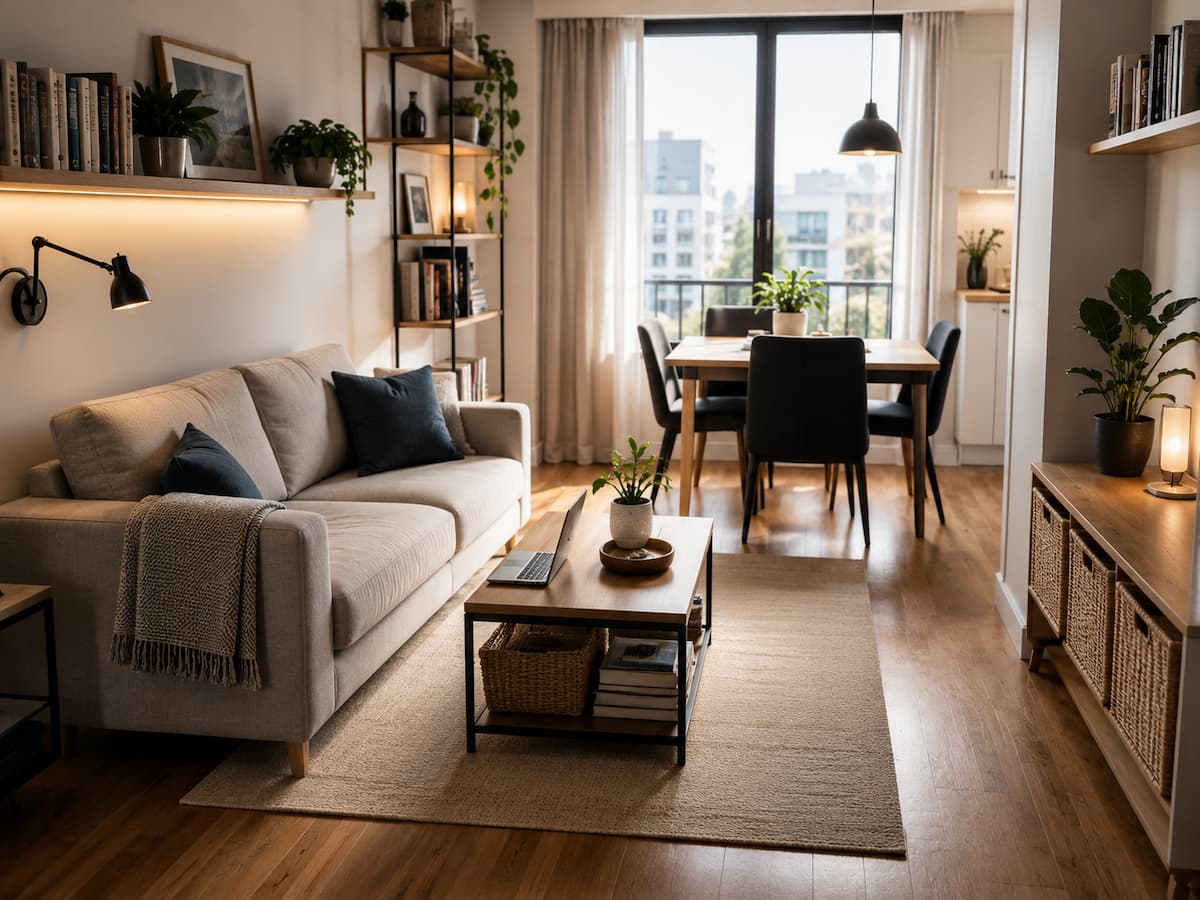
Good news: you can improve a compact living environment by altering how you use space. Move furniture a few inches to promote circulation. You can save floor space by using an empty wall. One piece of furniture that does two duties can replace another.
The goal is not to turn a tiny home into a showroom. Real routines, hobbies, visitors, meals, work, relaxation, and everyday goods must fit in a functioning area. The best changes simplify those tasks without fundamental changes.
Analyze the Room as Zones
In a small room, it’s tempting to push everything to the walls and leave a big empty space. That doesn’t always work. A better way is to consider what each room part needs to support. Living rooms may need space for sitting, reading, watching TV, working on a laptop, keeping books, and dining. Not all activities require separate rooms. They need specified sharing spaces. A short space beside a window could be a reading corner with a modest chair and floor lamp.
A wall near the entryway might hold coats and bags. The main seating area can be for conversation and leisure. A small workstation may operate better against an underutilized wall than alongside the sofa. Avoid using every surface for something new. A small area can feel chaotic with too many overlapping functions. One or two clearly defined zones work better than trying to use every square meter.
Repair Walking Paths Before Buying
Before replacing furniture, stroll through the room normally. See where you must turn, step around a table, move a chair, or squeeze between two things. These uncomfortable movements frequently stand out more than the absence of storage. Furniture should facilitate movement. Beautiful coffee tables that block the sofa-kitchen path are useless. In isolation, a huge armchair may be comfy, but it can hinder closet or door opening. Consider relocating one or two pieces before ordering replacements. Try the new setup for a day or two. This trial is free and often shows if the intended layout works during daily operations.
| Problem | Possible adjustment | Why it helps |
|---|---|---|
| Furniture blocks a route | Rotate or reposition the piece | Creates a clearer path without removing furniture |
| Room feels visually crowded | Remove rarely used pieces | Restores visible and physical space |
| Storage takes too much floor area | Use vertical wall space | Moves storage upward instead of outward |
| One surface performs too many jobs | Create separate activity zones | Reduces clutter and constant rearranging |
Use Vertical Space More Deliberately
Small homes often have more unused wall space than unused floor space. That makes vertical storage particularly useful. Shelves, wall-mounted cabinets, hooks, pegboards, and narrow storage units can hold everyday items without expanding the footprint of the room.
There is a practical limit, though. Covering every wall with shelves does not automatically make a room more functional. Storage should be placed where the items are actually used. Books belong near the place where you read them. Keys and bags need a convenient location near the entrance. Frequently used kitchen items should not be stored in an awkward high cabinet simply because it is available.
Open shelving can also create a maintenance problem if everything becomes visible. A few attractive or frequently used items can stay exposed while less attractive objects go into baskets, boxes, or closed storage. This gives you the benefit of vertical capacity without making the room look permanently busy.
Choose Furniture for Its Second Job
In a larger home, furniture can often have one clear purpose. A small living space benefits from pieces that can perform another useful function without becoming complicated.
A storage ottoman can provide seating, a footrest, and concealed storage. A narrow console can work as a desk when necessary. A dining table with a compact footprint can double as a workspace. A sofa with built-in storage may eliminate the need for a separate cabinet.
The important distinction is between genuine multifunctionality and novelty furniture. A piece that technically performs five functions but is difficult to open, move, or reconfigure may create more inconvenience than it solves. Choose secondary functions that align with your actual activities. The best multifunctional furniture is usually the furniture you can use normally without having to constantly transform it.
Make Storage Easier to Reach
Storage is only useful when people can access it without creating another problem. A deep cupboard may technically hold a large amount, but if reaching the back requires removing everything in front, the space will gradually become a dumping ground.
Small spaces benefit from storage that matches the size and frequency of the objects being stored. Shallow shelves can work well for books and small household items. Baskets can group loose objects that otherwise spread across surfaces. Drawer organizers can prevent small items from forming a single tangled collection.
Keep frequently used things in the easiest locations. Seasonal or rarely needed belongings can occupy higher shelves or less convenient storage. This simple distinction can make a compact room feel much more orderly because the objects you handle every day are no longer competing for the same small areas.
Clear Surfaces Before Adding More Storage
A crowded countertop or table often creates the impression that a room needs additional furniture. Sometimes the opposite is true. The surface is being used as temporary storage because objects do not have a convenient home.
Look at the items that repeatedly appear on the same surface. If mail accumulates beside the entrance, create a designated place for incoming papers. If chargers remain beside the sofa, keep a small charging station nearby. If blankets constantly sit on a chair, a basket next to the seating area may solve the problem.
This is more effective than simply buying a larger storage unit because it addresses the reason clutter keeps returning. The goal is not to hide everything. It is to make the correct location easier to use than the wrong one.
Use Lighting to Make the Room Work Better
Lighting can change how a small room functions without changing its dimensions. One bright overhead fixture may illuminate the entire room, but it does not necessarily provide the right light for reading, working, relaxing, or eating.
Adding smaller sources of light allows the same room to support different activities. A task lamp can define a workspace. A reading lamp can make a chair useful in the evening. Softer lighting near the sofa can create a comfortable area without illuminating the entire room at the same intensity.
Wall-mounted or slim lamps can be particularly useful where floor and table space are limited. The goal is not to add as many lights as possible. It is to place light where an activity actually happens.
Be Careful With Furniture That Is Too Large
One oversized item can dominate a small room. The problem is not only the physical footprint. Large furniture can reduce the amount of visible floor, narrow walking paths, and make other pieces feel squeezed into whatever space remains.
Measure the room before shopping and pay attention to more than width. Depth matters. Door swings matter. Drawer clearance matters. The route from the entrance to the furniture matters. A cabinet that fits perfectly against a wall may still be impractical if its doors cannot open properly.
Scale also matters visually. Several moderately sized pieces can sometimes make a room feel more flexible than one large statement piece. That does not mean small furniture is always better. A compact sofa that is uncomfortable will not improve the room simply because it saves space.
Reduce the Number of Things Competing for Attention
Functionality is partly physical and partly visual. When every shelf, wall, and tabletop is full, it’s harder to find what you need and to understand how the room is meant to be used.
You do not need an extreme minimalist approach. Instead, identify objects that are rarely used, duplicated, broken, or kept simply because there is technically enough room for them. Removing a few low-value items can make storage systems work better without adding a single new product.
This is particularly helpful before buying organizers. Storage products can make a collection look neater while also making it easier to keep things you no longer need. A small amount of editing first often produces a bigger improvement than another round of containers.
Make Changes in the Right Order
Small-space improvements are easier when you solve the biggest practical problems first. Start with movement and furniture placement. Then address storage. Thereafter, consider lighting, small accessories, and visual details.
Doing these steps in reverse can waste money. Buying decorative baskets before deciding where storage belongs may leave you with attractive containers that do not solve anything. Purchasing a new table before measuring the walking path can create another obstacle. Changing the layout first provides you information that makes later purchases more deliberate. A useful sequence looks like this:
- Observe where movement feels awkward.
- Remove or relocate furniture that creates unnecessary obstacles.
- Identify items that repeatedly create surface clutter.
- Provide important belongings convenient storage locations.
- Use suitable vertical space where floor storage is excessive.
- Add multifunctional furniture only where a real need remains.
- Improve task lighting and finishing details after the layout works.
This approach keeps small improvements from turning into a full decorating project.
When a Small Room Still Feels Crowded
If you have rearranged the furniture and the room still feels difficult to use, look for a mismatch between the room and the activities happening there. Perhaps a dining table is taking up space even though you rarely use it. Maybe a work desk has become the main storage area for unrelated objects. Perhaps the room is being asked to function as an office, dining room, entertainment area, storage room, and guest room simultaneously.
In that situation, the answer may be to reduce the number of permanent functions rather than finding another piece of furniture. Some activities can use the same surface at different times. Others may need to move to another part of the home.
It is also worth testing changes temporarily. Move a piece of furniture for several days before deciding that the new arrangement is permanent. Small homes reward experimentation because even minor changes can have noticeable effects on movement and storage.
A More Functional Small Space Does Not Need to Look Empty
The purpose of improving a small living space is not to remove everything until there is nothing left to enjoy. Books, artwork, plants, personal objects, comfortable furniture, and everyday possessions are part of a home. Functionality means those things have somewhere to live without interfering with the activities the room needs to support.
The most effective changes are often modest. A shelf moves upward. A chair changes position. A rarely used cabinet disappears. A basket takes over the job previously performed by a crowded chair. A desk moves closer to a power outlet. None of these changes requires construction, yet together they can make a room noticeably easier to live in.
Start with the problem you encounter most often rather than the room’s appearance. If you cannot move comfortably, please improve circulation. When surfaces are constantly filling up, it’s time to fix the storage locations. If you have to move furniture every time you change activities, consider changing the layout. Each change that solves a specific problem can make a small home considerably more practical while keeping it personal.
FAQs
1. What is the first step in renovating a small living room?
Start by considering furniture placement and traffic flow. A poor layout makes a room feel even smaller, regardless of how much storage space there is. Temporarily moving the largest piece of furniture can help you determine if the current arrangement is the main reason the space feels cramped.
2. Is multifunctional furniture always a good choice?
Not necessarily. Multifunctional furniture is most practical when the extra features actually meet your needs. A complex piece of furniture that constantly requires folding, moving, or rearranging might be less convenient than two simple, user-friendly pieces.
3. How can you increase storage space without making the room feel cramped?
Before adding more floor-standing furniture, consider vertical space. Wall shelves, hooks, shallow cabinets, and other vertical storage solutions increase storage capacity while maintaining enough walking space. Keep frequently used items within convenient reach and store less frequently used items in harder-to-reach spots.
4. Should a small room contain only small furniture?
Not necessarily. Furniture should be appropriately sized and comfortable, not just as small as possible. A well-proportioned sofa is often more effective than several small sofas that make a room look cluttered.
5. How can you make a small room look tidier without adopting a minimalist approach?
Instead of clearing everything out, try reducing visual clutter. Keep frequently used surfaces relatively clean and tidy, group similar items together, and find suitable storage spots for the loose items that tend to accumulate. In this way, the room provides space for personal belongings while maintaining freedom of movement.

ZapKido Editorial Team creates practical guides covering digital life, productivity, everyday technology, smart home solutions, and home organization. Our content focuses on clear explanations, useful settings, practical habits, and straightforward solutions that readers can apply in everyday situations. We aim to make technology and everyday tasks easier to understand without unnecessary complexity.