
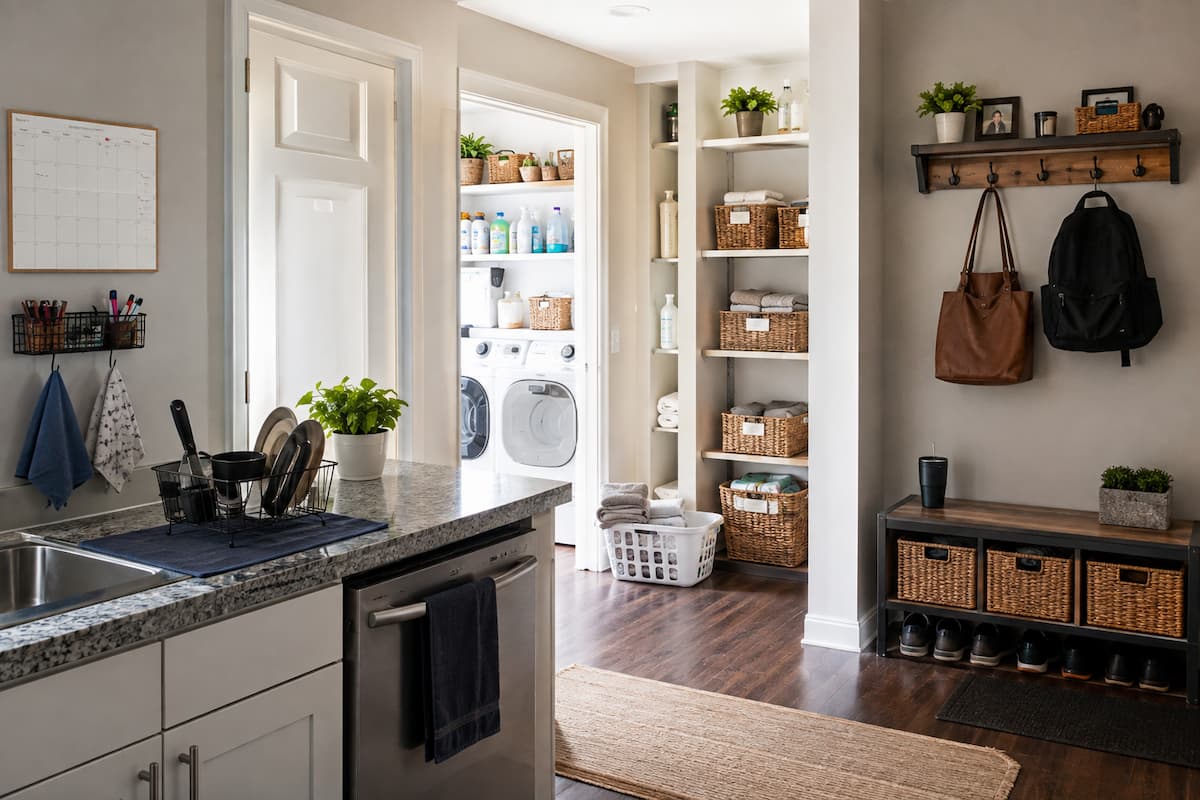
Start With the Chores That Keep Returning
Do not begin by trying to organize the entire house. Pay attention to the chores that seem to return before you have had enough time to enjoy being finished with them. For one week, notice where household friction appears. Perhaps the dishwasher stays full because nobody knows when it should be emptied. Maybe laundry piles up because clean clothes have no convenient place to go. Perhaps the bathroom becomes difficult to clean because the supplies are stored in another room. These recurring frustrations are useful clues. They show you where a small change could remove repeated effort. You are not trying to make the house perfect. You are looking for the points where an ordinary task requires more steps than it reasonably should.
| Recurring problem | Possible system | What it removes |
|---|---|---|
| Dishes remain in the sink. | Assign a clear time for the kitchen reset. | Uncertainty about when the task ends |
| Laundry piles up. | Separate collection from washing days | Repeated sorting and decision-making |
| Mail spreads across surfaces. | Create one incoming-paper location. | Searching and repeated relocation |
| Cleaning is postponed. | Store basic supplies near their point of use. | Extra preparation before starting |
The best system is usually the one that addresses a problem you can already describe clearly.
Give Everyday Objects a Natural Place to Land
Many household messes begin with objects that technically have a home but not a convenient one. Keys get placed on the nearest table because the key bowl is too far away. Shoes remain near the door because the shoe cabinet is difficult to open. Bags often end up on a chair, as there is no easy place to hang them. Instead of asking where an object should be stored, watch where people naturally put it. That location often tells you where a useful storage point should be created.
This does not mean putting storage everywhere. It means reducing the distance between an object and its natural destination. A small tray near the entrance may work better than an elaborate organizer hidden inside a cupboard. Hooks can be more practical than a wardrobe for bags that are used every day. If something repeatedly ends up in the wrong place, treat that as information rather than a discipline problem. The storage system may be fighting normal behavior.
Make the Kitchen Reset Almost Automatic
The kitchen is one of the easiest places for household work to multiply because several activities happen there at once. Cooking creates dishes, food preparation creates packaging and scraps, and eating adds another round of plates and glasses.
A simple reset system can reduce the accumulation. Decide what “finished kitchen” means in your household. It might mean food is put away, dishes are loaded or washed, the main preparation surface is clear, and obvious rubbish has been dealt with. It does not have to mean scrubbing every cabinet or deep cleaning appliances.
The useful part is defining the endpoint. Without one, cleaning can become an endless activity because there is always another surface that could theoretically be improved. Keep the items needed for the final reset close to the work area. If cloths are stored under the sink, rubbish bags are easy to reach, and the dishwasher can be loaded without moving several objects first, the final few minutes of kitchen work require less preparation.
Separate Laundry Into Stages
Laundry often feels like one enormous chore when it is actually several different jobs: collecting clothes, sorting them, washing, drying, folding, hanging, and putting everything away. Treating all of those stages as one task can make the pile seem larger than it really is. A more manageable system gives each stage a predictable place. Clothes can be collected in one or more hampers. Washing happens according to household needs rather than an unrealistic promise to do it every day. Clean clothes have a temporary location while waiting to be folded or hung, and the final storage step is kept simple.
There is no need to create a complicated color-coded laundry schedule unless your household genuinely needs one. The key is to avoid making the same decisions repeatedly. If everyone knows where dirty clothes go and what happens to clean laundry next, fewer piles develop in random places.
One common mistake is designing a laundry system around the ideal version of the household. If nobody consistently folds clothes immediately, do not build the entire routine around that. Make the intermediate stage orderly enough that delayed folding does not create another mess.
Keep Cleaning Supplies Close to the Mess
A small cleaning job becomes easier when the preparation is minimal. If the bathroom needs wiping but the cleaning cloth is downstairs, the spray is in a locked cupboard, and the spare supplies are somewhere else, a two-minute task can feel surprisingly inconvenient.
Keep appropriate basic supplies near the areas where they are regularly used, while following product safety instructions and keeping cleaning chemicals away from children and pets. A bathroom can have its own basic cleaning materials. Kitchen cleaning items can stay close to the kitchen. Frequently used cloths can have a designated place to dry.
This approach does not mean every room needs a complete cleaning kit. Some supplies can be shared. The aim is to reduce unnecessary trips when a small mess appears. It is also worth keeping a simple inventory of essential supplies. Running out of rubbish bags, detergent, or cleaning cloths at the exact moment you need them creates an avoidable interruption. A small reserve of frequently used items can make the routine more dependable.
Use a Small Daily Reset Instead of Constant Cleaning
Constantly cleaning is exhausting because it makes household work feel endless. A short reset at a predictable point can be easier to maintain. The reset does not need to cover the entire home. Focus on the areas that affect the next part of the day. In the evening, that might mean clearing the kitchen, returning obvious items to their places, and preparing anything needed for the morning. In the morning, it could mean putting away breakfast items and clearing the main living area.
The value comes from restoring the basic state of the room rather than chasing perfection. If the home starts the next day reasonably organized, small amounts of disorder are less likely to become a major cleanup later.
Different households will need different reset points. A family with young children may benefit from a late-afternoon reset. Someone who works from home may need a short workspace reset before finishing work. The system should fit the household’s natural rhythm.
Create a Home for Temporary Items
Some objects do not have an immediate final destination. Incoming mail needs attention. Packages may need to be opened later. Items that belong in another room may not be worth carrying immediately. Borrowed objects may need to be returned.
When there is no temporary location, these objects spread across whatever surfaces are available. A designated temporary basket, tray, shelf, or small area can contain them until the next sorting period. The important word is temporary. If the basket becomes a permanent storage unit for everything that has nowhere else to go, the system has stopped working. Please empty it regularly and decide what each item actually requires.
This idea is especially useful near entrances. A small landing area can prevent bags, receipts, keys, deliveries, and other everyday objects from taking over the first available table.
Make Household Responsibilities Visible
In a shared home, chores become more difficult when everyone assumes someone else will handle them. The problem is not always unwillingness. Sometimes the responsibility is simply invisible.
A shared calendar, household note, or simple recurring schedule can make ownership clearer. The system does not need to divide every task into equal mathematical portions. It needs to make important recurring responsibilities visible enough that they do not depend on one person remembering everything.
It also helps to distinguish between routine responsibilities and occasional jobs. Taking out rubbish may happen frequently, while cleaning a refrigerator may happen much less often. Putting both into the same daily list makes the system unnecessarily complicated. For families, children can also have age-appropriate household responsibilities. The useful principle is consistency rather than creating a large chore chart that becomes another thing for adults to manage.
Keep Weekly Maintenance Different From Daily Resets
Some household tasks do not need daily attention. Washing floors, cleaning certain appliances, changing bedding, checking supplies, and handling accumulated paperwork may work better as periodic maintenance.
Separating these jobs from daily resets prevents everyday routines from becoming too long. The kitchen can be returned to a usable state every evening without requiring a deep clean. Laundry can continue without turning every laundry day into a full household organization session.
A weekly review can also reveal small problems before they become annoying. You may notice that a particular storage area is overflowing, a frequently used product is nearly empty, or a household task keeps getting skipped. Fixing the system at that point is usually easier than waiting until the problem becomes urgent.
Do Not Build a System That Requires Perfect Discipline
The strongest household systems survive ordinary bad days. People get worn out. Work runs late. Children become difficult. Plans change. A system that works only when everyone follows every step perfectly is not a practical system.
Look for ways to create a reasonable fallback. If laundry cannot be folded immediately, clean clothes should still have a designated temporary location. If you miss the kitchen reset one evening, the next reset should restore order without an enormous cleanup. If something cannot be put away immediately, it should have a temporary home rather than becoming part of a new pile.
Convenience matters more than complexity. A system that requires six steps may look organized on paper, but a three-step system that people actually use will produce better results.
Change the System When the Problem Keeps Returning
Repeated mess is often a useful diagnostic tool. If the same pile appears in the same place every day, simply clearing it treats the symptom. Ask why that location attracts the objects.
Maybe the nearest storage is inconvenient. Maybe the object is used so frequently that putting it away immediately is unrealistic. Maybe the storage area is already full. Or perhaps the household has never agreed on where the item belongs.
Change one part of the system and observe what happens. Moving a basket closer to the stairs may reduce items left on the floor. Adding a hook near the entrance may prevent bags from landing on a chair. Keeping spare towels closer to the bathroom may help you from temporarily storing them in the hallway. You do not need to redesign the entire household every time something goes wrong. Small adjustments are usually easier to test and easier to keep.
The Best Household System Is Usually the Least Complicated One
A well-run home does not require a perfect schedule. It needs a few dependable arrangements that make repeated work easier. Objects need sensible places to land. Cleaning supplies need to be reasonably accessible. Recurring chores need clear ownership or timing. Frequently used areas need simple reset points.
Once those basics are working, household maintenance becomes less about repeatedly restoring order from scratch. You are creating conditions that help the home return to a usable state with less effort. Start with one recurring frustration. Do not buy anything until you understand why it keeps happening. Change the location, sequence, responsibility, or storage arrangement that is creating unnecessary work. Then live with the adjustment for a while.
If the problem becomes easier, keep the system. If it does not, please change it again. The goal is not to create an impressive household routine. It is to make ordinary life require fewer unnecessary decisions and fewer repeated corrections.
FAQs
1. Which household system should I implement first?
Start with the duty or reoccurring mess that bugs you the most. A system based upon a real problem is likely to be more useful than a broad routine arrangement. Once you have that system working, you may apply the same concept to another part of the home.
2. How do I make tasks simpler without spending money?
Start with placement and sequence. Place common supplies close to where you need them. Allow for a simple place for common things and create a simple order for common chores. And many of the household improvements involve reorganizing existing resources, not buying new organizers.
3. Does all housework need to be scheduled?
No. Scheduling is useful for jobs that reoccur, are simple to forget, or need shared accountability. Other activities can be worked on after they naturally come to a particular point. Scheduling every single task leads to needless administrative work.
4. What to do when your home system fails?
Look for what has changed. The home may have changed routines, more stuff, a new timetable, or a storage location that has become inconvenient. Don’t think that individuals only need more discipline, but adapt the system to the current scenario.
5. How do I simplify household systems?
The number of young people in the United States who are neither in school nor working is rising. If a task requires frequent updating, labels, reminders, and precise tracking simplify it. The best routine is the one where you don’t have to worry about the system itself.

ZapKido Editorial Team creates practical guides covering digital life, productivity, everyday technology, smart home solutions, and home organization. Our content focuses on clear explanations, useful settings, practical habits, and straightforward solutions that readers can apply in everyday situations. We aim to make technology and everyday tasks easier to understand without unnecessary complexity.