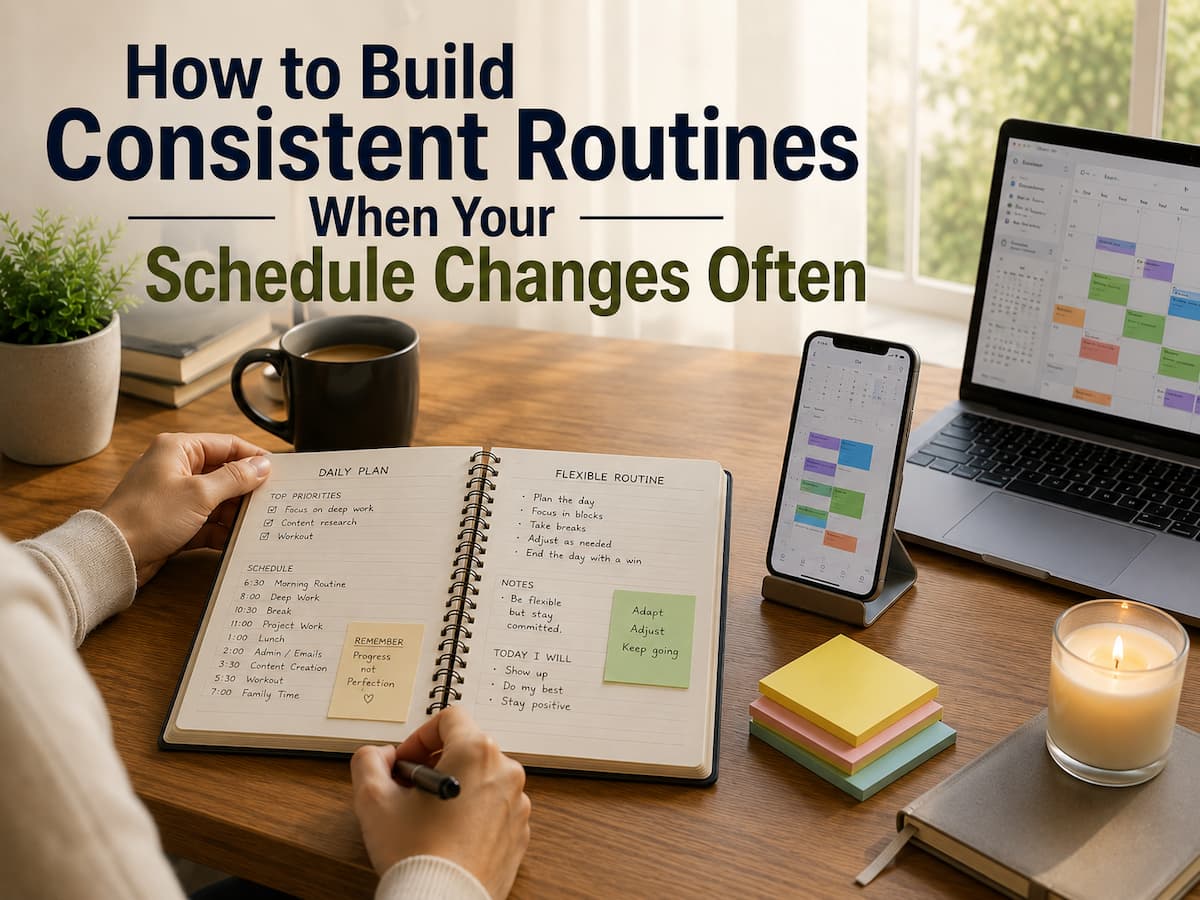
How to Build Consistent Routines When Your Schedule Changes Often
Why Life Changes Makes Routines Hard
Many people start routines with positive intentions. They get up earlier, exercise, read more, organize their work, or adopt healthier habits. Everything works for a few days. Then a meeting is moved, a family obligation arises, work becomes busy, or a typical day changes. Many issues are not discipline-related. Many routines fail because they aim for a flawless schedule instead of a realistic one. In real life, a routine that only works when every hour goes as planned is difficult to sustain. Most people don’t need stronger rules. They need adaptable systems.
Building consistency when your schedule fluctuates frequently requires habits based on flexibility rather than exact times. Instead of saying, “I must read at 7:00 every evening,” try saying, “I will spend 15 minutes reading whenever my evening becomes available.” Try not to eliminate daily structure. The goal is interruption-resistant construction. A flexible routine provides a solid foundation for unforeseen events. This method is ideal for individuals with variable work hours, family obligations, freelance schedules, school obligations, or hectic personal lives.
Priorities Should Guide Routines, Not Time Slots.
One of the most significant mistakes individuals make when designing routines is assigning a time to each behavior. Time-based routines work well for predictable schedules but fail when life is unpredictable. Prioritizing routines is best. Start by establishing your daily priorities. Cooking, doing a vital job, being well, spending time with family, learning a skill, and organizing your home are examples. Your routine is built on these priorities.
For instance, someone with shifting job schedules may not exercise every morning. They can set a regimen to exercise after waking up, before work, or after coming home. The habit is linked to a consistent life segment, not an hour. This strategy lowers frustration. Missing a time slot can feel like failure, but performing a vital task at another time maintains the habit. Consistency comes from repeating the habit, not following a daily timetable. When creating a routine, ask yourself, “What needs to happen regularly for my life to feel organized?” The answer usually shows desirable habits and adaptable activities.
Establish Stable Routine Anchors During Change
Routine anchors are crucial when schedules change regularly. Routine anchors are simple, stable actions or events that link other habits. These anchors provide the day’s rhythm even when things change. Wake up, have a drink, make breakfast, start work, finish work, eat dinner, and go to bed. These everyday events are helpful for forming new habits.
For instance, a regular writer need not set a writing time. They may associate writing with morning coffee. Another house organizer may spend five minutes tidying after dinner because that transition happens often. Anchors simplify habit recall. Instead of just incentives, your daily routine reminds you. Over time, the habit becomes part of your routine instead of a chore. Good anchors are basic. Attaching a complicated habit to a hectic situation frequently adds stress. Small, repetitive, and realistic routine anchors work best.
Make Daily Routine Variations
Routines often fail because people only create one ideal day. They can follow that schedule when they have time, but not during stressful or busy times. Having numerous routines makes consistency easy. Flexible routines usually have normal, shorter, and minimal versions. The usual version is your preferred regimen when everything goes well. Shorter version maintains critical practices when time is limited. The basic version keeps you from abandoning the routine on challenging days.
Language learners typically study for 30 minutes. On a busy day, they may review vocabulary for 10 minutes. On a challenging day, individuals may listen to a short lesson while doing something else. Each version maintains continuity. This method prevents all-or-nothing thinking. Many quit habits because they think a tiny effort is insignificant. Maintaining a habit is frequently more important than perfectionism.
Change Your Routine Without Starting Over
An unexpected schedule change doesn’t mean you have to rework your routine. Constantly building new systems can be stressful and lead to habitual abandonment. Learning to change little portions while protecting important habits is better. Think of your routine as a structure with important and flexible pieces. Preparing for work, taking care of personal duties, and maintaining critical habits are essential. Flexible portions can change, such as the time you finish a task or the order of less important tasks.
Someone who usually plans the week on Sunday night may have to reschedule it to Monday morning due to family obligations. The routine works. Only timing changed. Protecting the habit’s purpose is more important than its schedule. People abandon routines because they think changes mean their system is failing. In reality, any long-term regimen requires tweaking. Successful routines evolve. It recovers fast from alterations. Ask what must be preserved when your schedule is disrupted. Keeping your most critical routine active will mitigate the negative effects of momentary adjustments. Minor changes are easier to manage than full restarts.
Try Simple Tracking Instead of Complex Systems
People can comprehend their habits by tracking, but beginners often develop complicated systems. Using a sophisticated tracking approach can add to your workload. Tracking should aid your routine, not complicate it. A basic method usually works. Some prefer checking a limited list at night. Others utilize calendars, phone notes, or weekly reviews. The greatest option is one you can use without feeling overwhelmed.
Tracking should emphasize awareness over perfection. Missing a day doesn’t indicate the system failed. Information can explain patterns. Some habits may be easier following certain activities or require adjustment during hectic periods. Because they’re exhausted after work, someone usually doesn’t finish evening tasks. Instead of criticizing themselves, they can move key tasks earlier in the day or shorten the evening version. Tracking shows issues that memory alone misses. Is my routine making my life easier? The best tracking tools answer this question. The answer is usually no, so improve the routine design rather than add tracking.
Common Mistakes that Make Flexible Routines Harder
Many everyday issues stem from unreasonable expectations rather than inadequate planning. People schedule around their most productive days, forgetting that energy, responsibilities, and time shift. Routines should enhance your life. Changing too much at once is a common mistake. In one week, someone may wake up earlier, change their diet, exercise, manage their finances, and learn a new skill. These goals are reasonable, but handling numerous large changes at once can be stressful.
Misinterpreting lost days as failure is another mistake. An interrupted routine is typical. Resuming your routine without getting frustrated is key. Recovery provides long-term consistency. Some people construct motivation-driven routines. Sleep, stress, workload, and personal circumstances affect motivation. Better systems make key acts easier to remember and accomplish, reducing decision-making. An adaptable regimen should be beneficial, but constant stress may require system correction. Not creating a perfect schedule is the goal. The goal is to form habits that last through life’s changes.
Keep Your Routine Through Life’s Seasons
You may need to modify your routine in the future to keep it successful. Working hours, family situations, personal ambitions, and time availability can change. Expecting one routine to work indefinitely without change is unjustified. Reviewing your routine periodically keeps it useful; detailed evaluations are not needed daily. Simple monthly or seasonal reviews work. Ask if your behaviors support your priorities and if anything is too challenging
A student may base their routine on lessons and studying. That structure may not fit after graduation. An employee may need a new routine while starting a new job or adding duties. Changing the routine implies adjusting it to current needs, not losing consistency. Effective routines evolve with the user. These norms do not govern every instant. These systems guide while allowing for real-life flexibility. Most sustainable habits are simple enough to keep during hectic times and important enough to continue during peaceful times. Routines that work in both scenarios become habits rather than projects.
Returning, Not Being Perfect, Builds Consistency
Consistent routines are often misinterpreted as daily schedules with every duty at the proper moment. In truth, consistency is the ability to maintain important habits despite changes. Life always has interruptions, unanticipated tasks, and challenging days. A flexible routine provides a reliable structure without needing daily uniformity. Your system can handle change by focusing on priorities, setting routine anchors, preparing different habits, and changing when needed.
The best habits develop gradually. Small actions repeated over time are more stable than big plans that fail after weeks. Routines should simplify life, not add stress. The idea is not to control every part of your day when your schedule is constantly changing. Knowing what’s important, protecting routines, and having enough freedom to move forward are the goals.
FAQs
1. How long does it take to build a consistent routine?
The time required depends on the habit, your environment, and how realistic the routine is. Instead of focusing on a specific number of days, focus on creating a routine you can repeat regularly. A smaller routine that continues for months is more valuable than a demanding routine that lasts only a short time.
2. Should I follow the same routine every day?
Not necessarily. A consistent routine does not need to look identical every day. People with changing schedules often benefit from flexible routines with different versions depending on available time and responsibilities.
3. What should I do when I completely miss my routine?
Restart with the next available opportunity rather than waiting for a perfect moment. Many people lose progress because they believe they need to begin again on a specific day, such as the start of a new week. Returning quickly is more important than creating a perfect restart plan.
4. How many habits should I include in my routine?
There is no universal number, but beginners usually benefit from starting with a small number of meaningful habits. Adding too many changes at once can make the routine difficult to maintain. Build a stable foundation before expanding.
5. Can routines work for people with unpredictable jobs?
Yes. People with changing shifts or irregular schedules can still build routines by using anchors, priorities, and flexible habit windows instead of depending on exact times. The structure needs to match the reality of their schedule.

Abdul Rahman is a digital lifestyle writer and researcher who focuses on productivity, smart technology, personal finance, and practical home improvement tips. Through ZapKido, he shares simple, beginner-friendly guides designed to help readers build smarter habits, improve daily efficiency, and live a more organized digital life.