
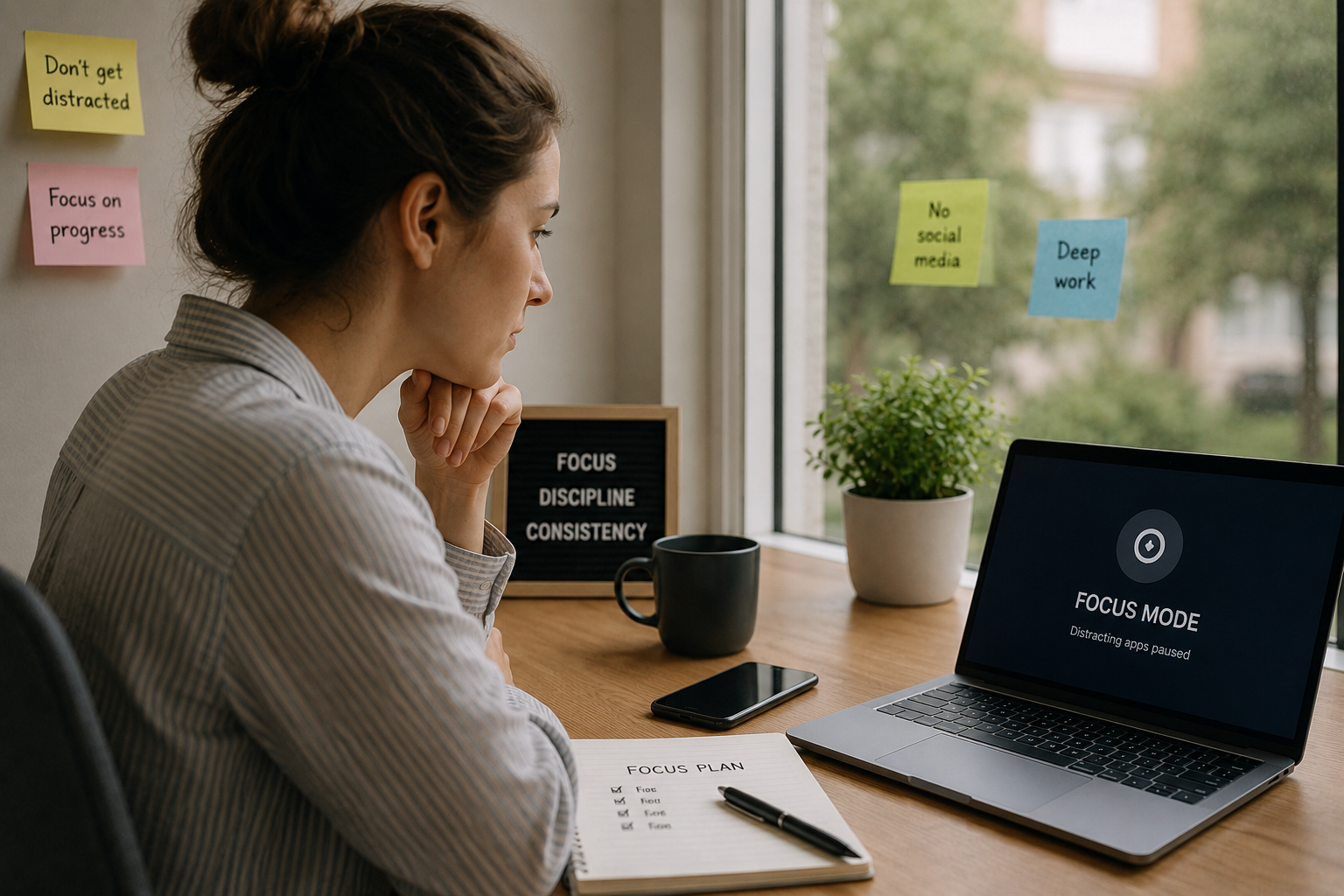
On a Tuesday in March, I timed myself. I sat down to write an article at 9:00 AM. By 9:47, I had checked my phone 11 times, opened Twitter twice, replied to a group chat, and completely forgotten what I was writing about. I had produced 87 words. Forty-seven minutes. Eighty-seven words.
That evening, I installed a screen time tracker. The number horrified me: 127 phone pickups in a single day. I was not using my phone. My phone was using me.
So I ran a 30-day experiment on myself. No apps. No expensive courses. Just a notebook, a kitchen timer, and a set of rules I designed based on research from UC Irvine, behavioral psychology, and my own failures. By Day 30, my phone pickups dropped to 34 per day. My average writing session stretched from 12 minutes to 47 minutes. And for the first time in years, I finished a book in under two weeks.
This article is the complete record of that experiment — what worked, what failed, and the exact steps you can take starting today.
Why the Digital World Makes Focus So Difficult
The digital world is not accidentally distracting. It is engineered to capture and hold your attention for as long as possible. Every notification, autoplay video, and infinite scroll feature is designed by teams of behavioral psychologists to exploit the same dopamine loops that drive slot machine addiction.
According to 2026 research on social media attention spans, the average user now toggles between apps every 40 seconds. Knowledge workers need approximately 23 minutes to fully regain focus after a digital interruption. And 76% of people respond to smartphone notifications within five minutes of receiving them — effectively making every notification a guaranteed focus break.
I experienced this personally. My phone was not just a tool; it was a slot machine in my pocket. Every buzz promised something novel, and my brain learned to crave that novelty even when nothing was buzzing. I would feel phantom vibrations in my pocket—a phenomenon experienced by up to 78% of heavy smartphone users.
My 30-Day Focus Experiment: The Rules
Before starting, I established five non-negotiable rules based on research from the UNC Learning Center, behavioral psychology, and productivity science:
- Phone in another room during work blocks. Not on the desk. Not face-down. In another room. Research shows the mere presence of a smartphone reduces cognitive performance, even when it is turned off.
- One 25-minute focused block, then a 5-minute break. Classic Pomodoro technique. The timer creates a clear boundary between “focus time” and “break time.”
- No notifications before 10 AM. The first hour sets the tone for the entire day. Nearly 85% of people check their phones within 10 minutes of waking—I refused to be one of them.
- Grayscale mode after 6 PM. Bright colors trigger dopamine responses. Grayscale makes the screen less visually rewarding and reduces the urge to scroll.
- Weekly review every Sunday. Track phone pickups, note what triggered distractions, and adjust the rules.
I tracked everything in a paper notebook. Date, time, what I was doing when I got distracted, and what the distraction was. This metacognition—”thinking about thinking”—is recommended by the UNC Learning Center as a way to recognize the mental states that trigger distraction.
Week-by-Week: What Actually Happened
The Withdrawal Phase
Phone pickups: 127 → 98 (still high, but down 23%)
Average focus session: 12 minutes → 18 minutes
What happened: The first three days were brutal. I reached for my phone constantly and found it missing. I felt anxious, like I was missing something important. By Day 4, something shifted. The anxiety faded into boredom—and then the boredom became… quiet. I started noticing things again. The sound of birds outside. The feeling of my pen on paper. My brain was recalibrating.
Biggest mistake: I tried to “replace” phone time with reading on my phone. It did not work. The device itself was the trigger. I switched to physical books, and it made a massive difference.
The Adjustment Phase
Phone pickups: 98 → 67
Average focus session: 18 minutes → 31 minutes
What happened: The Pomodoro technique started feeling natural. I could complete a 25-minute block without reaching for my phone. During breaks, I allowed myself to check it—but only in the other room. This created a physical boundary that my brain began to respect.
Surprising discovery: Most of my “urgent” notifications were not urgent at all. Two group chats, one promotional email, and a weather alert. Nothing that could not wait 25 minutes. I started turning off non-human notifications entirely.
The Breakthrough Phase
Phone pickups: 67 → 45
Average focus session: 31 minutes → 42 minutes
What happened: I experienced my first “deep work” session. Two hours passed without me checking my phone once. I wrote 1,800 words in a single morning — more than I used to write in three days. The quality was better too. My ideas connected more clearly when they were not interrupted every few minutes.
New habit formed: I started using the “hallway “rule”—keeping my phone outside the bedroom entirely. My sleep improved noticeably within four days. I fell asleep faster and woke up feeling more rested.
The Stabilization Phase
Phone pickups: 45 → 34
Average focus session: 42 minutes → 47 minutes
What happened: The new habits felt automatic. I no longer had to force myself to put the phone in another room—I just did it. My brain had rewired. The urge to check my phone during work blocks had diminished to a faint whisper.
Unexpected benefit: I became more present in conversations. When talking with friends or family, I was not mentally half-checking my phone. People noticed. My partner commented that I seemed “more here” during dinner.
The 7 Techniques That Actually Worked
Not every technique I tried succeeded. Here are the seven that made a measurable difference, ranked by impact:
Keeping my phone in another room during work blocks was the single most effective change. The UNC Learning Center recommends putting your phone in your bookbag or another room during study time. I took this further—my phone lives in the kitchen during my morning work blocks. The 20-second walk is enough friction to break the automatic checking habit.
Why it works: Behavioral research shows that making an unwanted behavior harder to perform significantly reduces how often it occurs. Small obstacles create just enough pause to interrupt autopilot.
I use a $3 kitchen timer, not a phone app. The physical act of winding the timer signals “focus mode” to my brain. Twenty-five minutes of work, five minutes of break. After four cycles, a 20-minute break.
Why it works: The BBC Maestro guide on managing digital distraction notes that breaking work into short, manageable intervals helps maintain focus and prevent burnout. Knowing a break is coming soon makes it easier to resist checking your phone during the work block.
I did not just “reduce” notifications. I eliminated all non-human notifications. No promotional emails buzzing. No app updates. No social media alerts. Only texts, calls, and calendar reminders remain.
Why it works: Research shows 76% of people respond to notifications within five minutes. Every notification is a guaranteed interruption. By eliminating them, I removed the trigger entirely rather than trying to resist it.
I switched my phone to grayscale (black and white) every evening. The colorful icons that normally trigger dopamine responses became dull and unappealing.
Why it works: AppBlock’s research on phone addiction notes that bright, saturated colors are deliberately used in interface design to trigger dopamine responses. Grayscale disrupts this feedback loop, making interactions feel less stimulating. Users who adopt grayscale often report reduced stress and a stronger sense of control.
I do not touch my phone before 10 AM. I use a traditional alarm clock. The first hour of my day is for coffee, journaling, and planning — not reacting to whatever the internet threw at me overnight.
Why it works: Nearly 85% of people check their phones within 10 minutes of waking. This immediately puts the brain into a reactive state. By protecting the first hour, I start the day in control rather than in response mode.
For complex tasks, I now start with pen and paper before touching a screen. Planning an article? I outline it in a notebook first. Solving a problem? I sketch it out physically.
Why it works: The ADHD specialist resource on phone addiction recommends using physical planners to eliminate excuses to check your phone. The tactile engagement of writing activates different cognitive pathways and reduces the temptation to switch to a digital distraction.
Every Sunday, I spend 15 minutes reviewing my distraction log. What triggered me most? When did I break my rules? What will I adjust next week?
Why it works: The UNC Learning Center recommends practicing metacognition — observing the moods, thoughts, and mental states that tempt you to pick up your phone. With practice, you recognize when you are prone to distraction and can intervene before it happens.
What Failed (And Why)
Not everything worked. Here are the three techniques I abandoned and why:
Website Blockers and App Limits
I tried browser extensions and phone app limits. They lasted three days. I found workarounds immediately—using a different browser, asking a friend to send me a link, and simply disabling the limit when “I really needed to check something.”
Lesson: Digital restrictions on digital devices are too easy to override. Physical and environmental changes are harder to bypass.
“Just Use Willpower”
I told myself I would simply check my phone less. This failed within hours. Willpower is a finite resource that depletes throughout the day. By 3 PM, I had used it all on other decisions and caved to every notification.
Lesson: Willpower is not a strategy. It is a backup plan. Design your environment so you do not need to rely on it.
Reading on My Phone
I tried replacing social media with reading ebooks on my phone. The device itself was the trigger. I would open the Kindle app and find myself in Instagram 30 seconds later. Muscle memory is powerful.
Lesson: If the device is the problem, the solution cannot involve the same device. Physical books or dedicated e-readers work better.
How to Start Your Own 30-Day Focus Experiment
You do not need to copy my exact rules. But here is a starter framework you can adapt to your life:
| Day | Action | Time Required |
|---|---|---|
| 1 | Install a phone pickup tracker (iOS Screen Time or Android Digital Wellbeing). Establish your baseline. | 10 minutes |
| 2 | Turn off all non-human notifications. Keep only texts, calls, and true emergencies. | 15 minutes |
| 3 | Buy a kitchen timer or use a physical alarm clock. Remove your phone from your bedroom. | 30 minutes |
| 4–7 | Practice one 25-minute focus block daily. Phone in another room. Log distractions in a notebook. | 25 minutes + 2 minutes logging |
| 8–14 | Increase to three focus blocks per day. Add grayscale mode after 6 PM. | 75 minutes total |
| 15–21 | Add the “first hour rule”—no phone before a set time. Expand to five focus blocks. | 2 hours total |
| 22–30 | Full system running. Weekly Sunday reviews. Adjust rules based on your data. | 15-min review weekly |
Sources and References
- Mark, G. (2023). Attention Span: A Groundbreaking Way to Restore Balance, Happiness, and Productivity. Hanover Square Press.
- Mark, G., Gudith, D., & Klocke, U. (2008). The Cost of Interrupted Work: More Speed and Stress. University of California, Irvine. Proceedings of the SIGCHI Conference on Human Factors in Computing Systems.
- University of North Carolina Learning Center. (2026). Digital Distractions: Tips and Tools. Retrieved from learningcenter.unc.edu
- Springer. (2025). Digital Distractions in Education: A Systematic Review of Research on Causes, Consequences, and Prevention Strategies. Retrieved from link.springer.com
- Speakwise App. (2026). Attention Span Statistics 2026: Focus Duration, Digital Shrinkage, and Cognitive Decline. Retrieved from speakwiseapp.com
- SQ Magazine. (2026). Social Media Attention Span Statistics 2026: Viral Content Data. Retrieved from sqmagazine.co.uk
- AppBlock. (2026). How to Break a Phone Addiction: Psychology, Stats, and Practical Tips. Retrieved from appblock.app
- BBC Maestro. (2024). Managing Digital Distraction: 10 Tips to Stay Focused. Retrieved from bbcmaestro.com
- ADHD Specialist. (2026). ADHD & Phone Addiction: 11 Strategies to Reclaim Your Focus. Retrieved from adhdspecialist.com
- TeachThought. (2025). 25 Tips To Reduce Digital Distractions And Improve Your Focus. Retrieved from teachthought.com

Abdul Rahman is a digital lifestyle writer and researcher who focuses on productivity, smart technology, personal finance, and practical home improvement tips. Through ZapKido, he shares simple, beginner-friendly guides designed to help readers build smarter habits, improve daily efficiency, and live a more organized digital life.